How the Brain Reroutes Movement Under Threat
Jan 01, 2026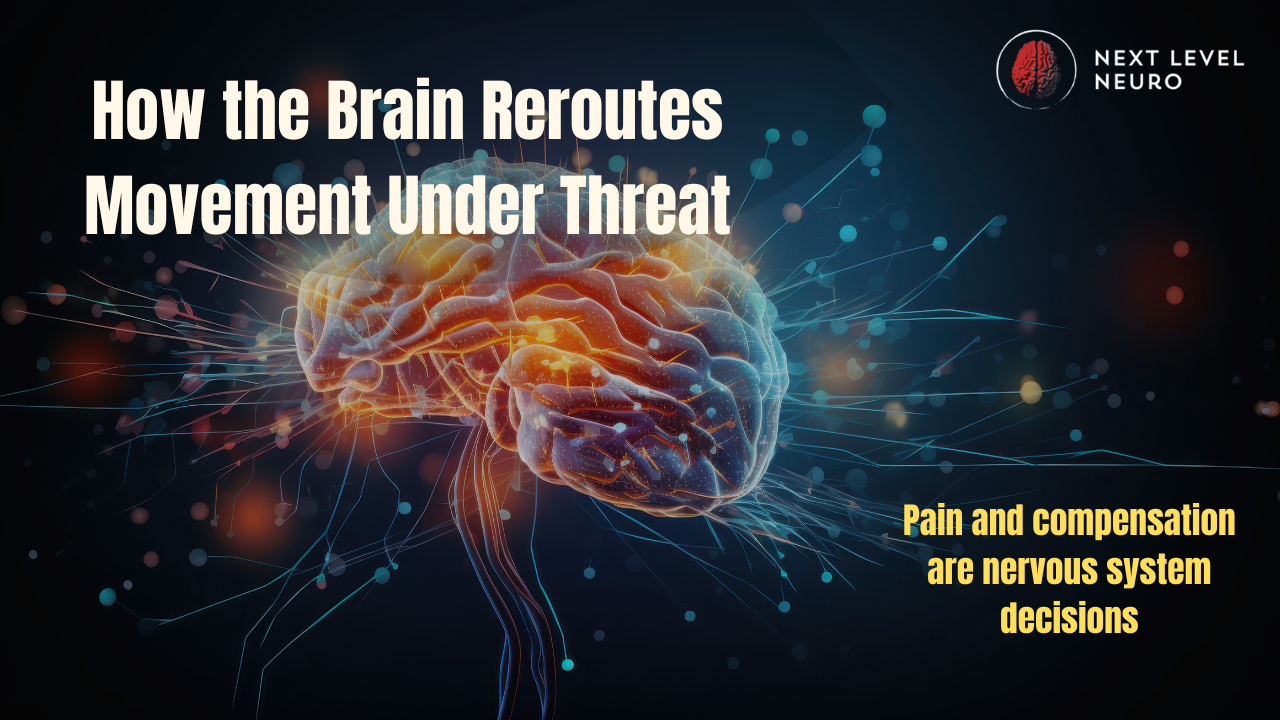
Why Pain, Compensation, and Plateaus Are Nervous System Decisions
The Question This Article Answers
How does the brain reroute movement under threat, and why does this override biomechanics, strength, and mobility work?
The Direct Answer (Brain-First): When the brain perceives threat, it reroutes movement to protect survival, not performance. This changes muscle activation, joint loading, coordination, and pain output even when strength and mobility are “good.” These patterns are nervous system adaptations driven by safety perception. Until threat is reduced and neural safety is restored, movement stays compensatory, inefficient, and often painful despite correct biomechanics.
What It Means When the Brain “Reroutes” Movement
Movement does not begin in muscles.
It begins as a decision inside the nervous system.
Before any joint moves or muscle fires, the brain answers one question.
Is this safe enough to allow?
When safety is perceived, movement flows efficiently.
When threat is perceived, the brain alters output to protect the system.
This is what we mean by rerouting.
Rerouting is not random.
It is a brain-first strategic process.
The brain prioritizes stability, predictability, and survival over efficiency, strength, or symmetry.
That means:
-
Certain muscles overactivate
-
Others shut down
-
Joint motion becomes restricted
-
Pain may appear as a protective signal
These changes are not errors.
They are adaptive responses.
Why Biomechanics Alone Fails to Explain Rerouted Movement
Biomechanics tells us how movement should occur under ideal conditions.
Bioechanics explains:
-
Joint mechanics
-
Force production
-
Leverage and torque
-
Muscle actions and sequencing
What biomechanics does not explain is why the same body moves differently under threat.
Two people can have:
-
Identical strength
-
Similar mobility
-
Clean movement screens
Yet one compensates and hurts, while the other moves freely.
This is where biomechanical reasoning breaks down.
The nervous system does not care if movement looks correct on paper.
It cares whether the environment, sensory input, and internal state feel safe with each client.
If safety is compromised, biomechanics becomes irrelevant.
The Neural Mechanisms Behind Rerouted Movement
When threat is perceived, several systems shift simultaneously.
Protective Muscle Strategy
The brain increases tone in stabilizing muscles to reduce perceived risk.
This often looks like “tightness,” but it is neurological, not structural.
Altered Motor Mapping
The brain simplifies movement patterns to reduce complexity.
Fine motor control decreases.
Gross, rigid strategies dominate.
Sensory Distortion
Vision, balance, and proprioception become less accurate under threat.
When sensory input is unclear, the brain limits movement to stay safe.
Pain as an Output
Pain emerges as a warning signal, not as proof of damage.
It is the brain’s way of enforcing protection.
None of these changes originates in the tissue.
They originate in threat perception.
Practitioner Implications: Why Clients Get Stuck
This is why:
-
Mobility gains disappear after sessions
-
Strength plateaus despite progressive loading
-
Pain returns after “successful” rehab
-
Clients relapse even when compliant
The nervous system never updated its safety assessment.
Strength improved.
Mobility improved.
But the brain never learned that movement was safe.
Without addressing the neural layer, results remain fragile.
Case Study Example: Rerouting Without Injury
A client presents with persistent hip pain and limited rotation.
Imaging is clean.
Strength tests well.
Mobility work helps temporarily.
Neurological assessment reveals:
-
Visual instability
-
Poor vestibular tolerance
-
High baseline sympathetic tone
When vision and balance inputs are addressed, hip range improves immediately.
Pain decreases without stretching or loading.
Nothing changed in the hip tissue.
The brain simply released protection.
This is rerouting in action.
How Applied Neurology Changes the Outcome
Applied neurology works upstream of mechanics.
Instead of asking only:
-
What muscle is tight?
-
What joint is restricted?
It asks:
-
What input is driving threat?
-
Where is safety unclear?
-
Which system is limiting output?
By addressing:
-
Vision
-
Vestibular input
-
Proprioception
-
Breathing and regulation
The brain updates its internal map.
When the brain feels safe, movement reorganizes naturally.
This is not a workaround.
It is how the nervous system is designed to function.
How This Fits the NLN Framework
At Next Level Neuro, this process is structured through the Transformation Ladder:
-
Regulation before strength
-
Fuel before adaptation
-
Sensory clarity before integration
-
Integration before performance
-
Frontal lobe engagement for long-term change
Rerouting resolves when the nervous system climbs the ladder in the correct order.
Biomechanics still matter.
They simply cannot lead.
The brain is the governing center of the body.
So everything above the neck affects everything below the neck.
Once the brain's threat perception calms down, all the biochemical education that practitioners have learned starts to work and stick.
Where to Go Deeper
To expand on this model, explore:
For practitioners ready to implement this clinically:
This Is The Next Generation's Health Education
When movement looks dysfunctional, it is often functioning exactly as the brain intends.
Pain, compensation, and plateaus are not failures of willpower or tissue.
They are signals that the nervous system is protecting.
When you change safety, movement changes with it.
That is how the brain reroutes movement under threat.
And that is where lasting results begin.
FAQ: How the Brain Reroutes Movement Under Threat (For Practitioners)
FAQ 1: What does it mean when the brain “reroutes” movement under threat?
When the brain detects threat, it shifts movement output toward protection.
This rerouting changes coordination, muscle activation, joint loading, and range of motion to reduce perceived risk.
The result can look like compensation, stiffness, or instability, even when strength and mobility appear adequate.
FAQ 2: Why do clients compensate even when biomechanics look “good”?
Because biomechanics describes how movement can occur, not whether the nervous system will allow it.
If the brain perceives threat, it prioritizes stability and predictability over efficiency and symmetry.
Compensation is often a safety strategy, not a mechanical mistake.
FAQ 3: How does threat change pain, strength, mobility, and coordination?
Threat increases protective tone, reduces fine motor control, and can amplify pain as a warning signal.
Strength output often drops because the nervous system limits force production when safety is unclear.
Mobility can also decrease because the brain restricts the range it does not trust.
FAQ 4: Is rerouted movement a sign of weakness or dysfunction?
Not necessarily.
Rerouting is often an adaptive response from a nervous system trying to stay safe.
It becomes a problem when the protective strategy persists after the original threat has passed, leading to ongoing pain, compensations, and training plateaus.
FAQ 5: What sensory systems commonly drive rerouted movement?
Vision, vestibular input, and proprioception are common drivers because they shape the brain’s map of position, balance, and movement prediction.
If any of these inputs are distorted or poorly tolerated, the brain may increase protection and alter movement output.
FAQ 6: Why does mobility or pain relief sometimes improve instantly with neuro drills?
Because the limiting factor is often neural safety, not tissue length or strength.
When a drill improves sensory clarity or reduces threat, the brain can release protective braking immediately.
This can create rapid changes in range of motion, pain sensitivity, or movement quality.
FAQ 7: How does applied neurology differ from corrective exercise in this context?
Corrective exercise often targets movement mechanics directly.
Applied neurology targets the inputs and nervous system state that determine whether movement is allowed.
By improving sensory accuracy and reducing threat, mechanics often improve without forcing structural change.
FAQ 8: Why do clients relapse after rehab if tissue is healed?
Because tissue healing does not guarantee nervous system safety.
If the brain still predicts danger based on memory, fear, or sensory mismatch, it maintains protective output.
Relapse often reflects unresolved threat perception, not a return of tissue damage.
FAQ 9: What is the first practical step to address rerouted movement?
Start by assessing whether the nervous system perceives movement as safe.
Look for signs of heightened threat such as breath holding, guarding, reduced tolerance to load, balance, or visual instability, and inconsistent performance.
Then apply targeted inputs and reassess immediately.
FAQ 10: Does this mean biomechanics are no longer important?
No.
Biomechanics are important, but they are incomplete without a nervous system context.
Applied neurology helps determine when the brain is ready to express strength, mobility, and skill.
When neural safety is addressed, biomechanics become more effective and results last longer.
Want more information on our Mentorship
and Programs?
We hate SPAM. We will never sell your information, for any reason.